Magic Integration is the enterprise integration platform, the applications we build on top of it, the AI engineering that makes those systems answerable, and the managed IT services that keep all of it running after go-live. One division of Magic Software Americas. One P&L. Nothing subcontracted.
When someone says integration, they usually picture one pipe between an ERP and one other thing. That is a project. What you actually own is an estate — every place a number leaves one system and has to arrive, correct and on time, in another. Magic XPI is an enterprise integration platform, and the word enterprise is doing real work in that sentence.
ERP
Orders, items, costs, inventory, GL. The system of record that every other system wants to read from and almost none of them are allowed to write to.
CRM
Quotes and accounts that have to become real orders without a person retyping them. Salesforce, Dynamics, SugarCRM.
WMS
Pick, pack, ship and cycle counts. The warehouse knows what is on the shelf hours before the ERP does.
MES
Work orders down, completions and scrap back up. The layer that decides whether your routings reflect reality.
HR
Hires, moves and exits that should provision an account, a badge and a training record without three tickets.
Finance
AP, AR, tax, banking and consolidation. Close cycles that stall because a subledger never got the file.
Support
Cases, RMAs and field service calls that need entitlement and shipment history to be answerable in one screen.
Historians
Tags, trends and time-series. Decades of process truth that finance and planning have never once queried.
Plant floor
Counts, states, downtime reasons and quality results, moving up through OPC UA and MQTT instead of a clipboard.
How the estate is actually held together today
What changes when the estate has one owner
Count your own handoffs before you scope anything. Every one of them is a connector, a script somebody left behind, or a person retyping. Only the first of those three has an owner.
We build and own this software. That matters when something breaks at the layer nobody else will claim, because the engineer who can fix it works here.
Integration Platform
Enterprise integration across ERP, CRM, WMS, MES, HR, finance, support, historians and the plant floor. Code-free flow design, event-driven execution, 100+ pre-built and certified connectors, and one console where every flow either ran or told you why it did not.
Application Development
The application layer on top of the systems you already run. Magic SmartUX builds mobile and web experiences against existing enterprise logic, so the warehouse, the field tech and the plant supervisor each get a screen that fits the job instead of an ERP form that fits nobody.
Finance & Plant Apps
Four apps on one governed data layer: Finance Eye for order and invoice capture, Plant Finance for real-time job cost, and Plant Analytics and Plant Modeling for floor visibility. Every app reads through Data Hub on Magic XPI rather than wiring itself into your control systems. We are honest about where it sits: the plant apps are early, with one production customer, and we scope them on an integration foundation.
AI Governance Layer
A model-agnostic governance layer between your language models and your operational systems. It decides what a model may see, what it may do, and what gets written down about it. Three deployment modes: your cloud with controls, a private VPC, or air-gapped on-prem.
If you are the person who has to decide whether this is real software or a services shop with a favorite framework, this section is for you. Magic has been building integration software since 1983. Magic XPI is our product, on our own middleware, with our own connector catalog.
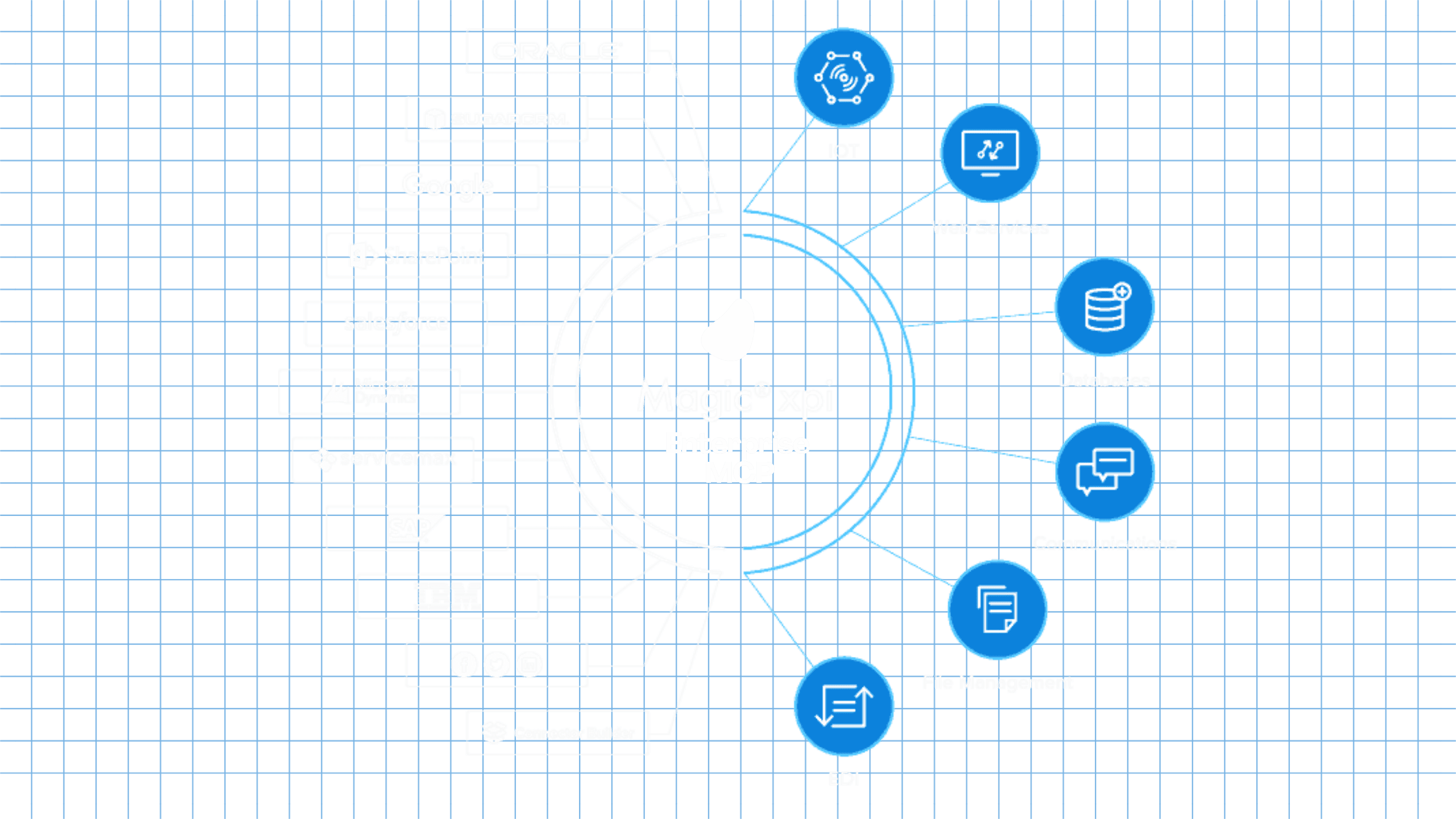
Certified means tested against the vendor's own interfaces and maintained through their release cycles — not a generic REST call pointed at an endpoint and called an integration. When SAP, JD Edwards or Epicor change, the connector is our problem to keep current, not yours.
Flows are built visually: triggers, steps, branches, mappings, error paths. That is not a convenience feature, it is a maintenance strategy. Three years from now the flow is still readable by whoever is on call, instead of being a binary nobody will touch.
A flow can fire on a record change, a queue message, a file arriving, an MQTT topic or an API call, as well as on a schedule. Batch windows exist because the tooling needed them. Yours should exist because the business wants them.
Flow state lives in our own in-memory engine rather than being parked in a database between every hop. That is what gives the platform its throughput profile, its high-availability behavior and its ability to resume a partially completed transaction instead of replaying it and double-posting.
Multiple servers share the same flow definitions and the same state, so a node going down is a failover, not an outage with a manual cleanup afterward. Monitoring, alerting and retry policy are platform-level, which means every flow inherits them.
The same platform runs in your cloud tenant, in your data center, or split across both — which is the common case, because the ERP is hosted and the historian is never leaving the plant. Governance and data residency decide the topology; the flows do not change.
The evaluator's shortcut
Read the connector list. It is the fastest way to tell a product from a promise.
Deep, specific experience in the platforms that run mid-market and enterprise manufacturing and distribution. Not a list of logos — a set of connectors, data models and upgrade scars.
SAP ERP and SAP Business One. IDocs, BAPIs and modern APIs, with the master-data direction settled before the first flow ships.
See the detailEpicor Kinetic and its service layer, connected to commerce, CRM, EDI partners and the floor without customizing the ERP into a corner.
See the detailDistribution on Eclipse, connected to web storefronts, supplier catalogs, pricing and warehouse execution.
See the detailEnterpriseOne and World. Orchestrations, business services and the certified connector behind the credential below.
See the detailInfor CloudSuite, LN and M3, integrated through ION-adjacent patterns and direct APIs rather than one-off extracts.
See the detailThe credential that is hard to copy
The only Oracle Validated Integrator with a certified JD Edwards connector in the Americas.
We are also an Oracle Platinum Partner. Validation means Oracle tested the connector against JD Edwards and signed off — which is a different conversation than a vendor telling you they can probably integrate it.
The system of record, the storefront, the directory and the floor all have to agree, and no single team is accountable for the seam between them. That is the work this group takes — named people, not whoever is free that sprint.
Over a hundred pre-built and certified connectors. The hard jobs start from something that already runs against the real API, not from a first integration written under a deadline.
Three and four systems in one flow, with the master-data direction and the failure behavior settled before the first mapping ships.
Decades in the industries where a broken interface stops a line or a truck. The edge cases are familiar because we have already been paged for them.
A stalled project, a go-live with a date already promised, a system the last team could not reach. We take the work at that stage, and we take it often.
Connect, extend or migrate the system of record without a rip-and-replace.
Trading partner onboarding, maps and acknowledgments that stop living in a mailbox.
One governed integration plane instead of six tools each owning two flows.
Move workloads without severing the on-prem systems that are staying put.
Storefront to ERP: inventory, pricing, orders and status, in real time.
Quote to cash applied, with every handoff automated and measurable.
Engineering change flowing to ERP and the floor without a spreadsheet in between.
One hire event provisioning accounts, access and training across every system.
Governed, auditable access from models to live operational data.
The reason people work around your ERP is rarely the ERP. It is the screen. A receiving clerk should not navigate four tabs to post a pallet, and a field technician should not be handed a desktop form on a phone. So we build the application the job actually needs, on top of the systems you already run, with Magic XPI handling everything behind it.
Customer outcome
50%
reduction in development costs
Not by writing less software — by writing it once. One application definition, delivered across the channels their teams actually use, with the enterprise logic behind it left intact.
What we build most often
Our AI engineering is in-house, and it starts from an unglamorous observation: the pilot did not fail because the model was not smart enough. It failed for two reasons, and both of them are data problems wearing an AI costume.
Failure one
A model asked about a late order, a margin swing or a line stoppage can only reason over what it was handed. Hand it a PDF export and a document index, and it will still answer — confidently, in a complete sentence, with a number it constructed. That is not the model misbehaving. That is a model doing its job on an inadequate context.
Failure two
Standard cost is not actual cost. The routing says the machine runs at a rate it has not held in two years. The ERP has not heard from the floor in days, so on-hand is a guess with a timestamp. Give a model perfect access to that and you get fluent, well-sourced, confidently wrong answers — which is strictly worse than no answer, because now someone acts on it.
The governed answer
Magic MCP is a model-agnostic governance layer. It defines which systems a model may reach, which records inside them it may see, which actions it is allowed to take, and what gets logged about every one of those decisions. Because it is model-agnostic, the model you choose this year is a configuration, not an architecture commitment. And because Magic XPI is already connected to the ERP, the CRM, the WMS, the historian and the floor, the context the model reads is live and current rather than exported and stale.
What we actually do
Fix the inputs first
Real production data, real actual cost, current inventory. The unglamorous part is the part that decides whether any of it works.
Govern the access
Scoped permissions, audit trails and human approval on anything that writes.
Stay model-agnostic
We integrate the models you have chosen. We do not sell you ours, because we do not have one.
Ship something narrow
One question, answered correctly and repeatably, beats a platform nobody trusts.
Integration that nobody maintains becomes the next generation of brittle scripts. Managed IT services and lifecycle support are how what we build stays working — through ERP upgrades, platform releases, staff turnover and the enhancement requests that arrive the week after launch. It is the same team, under the same P&L, which is why there is no handoff to argue about.
The integration plane, the applications on top of it and the servers underneath are monitored, alerted and patched on a schedule somebody owns. When a flow fails at 3 a.m., the alert goes to an engineer who already knows the environment.
ERP upgrades, platform releases, OS and database end-of-life, certificate rotation. The work that never makes a roadmap and always makes an incident. We plan it and we execute it.
Every real deployment generates a queue of small changes in its first year. We staff for that queue instead of treating each item as a new statement of work.
Day-to-day IT support for the people using what we built, with escalation into the same engineering team rather than a ticket thrown over a wall.
Part of the combined Magic group: 15,000+ professionals, 6,000+ customers, 50+ countries, in business since 1983. What follows is closer to home.
Michelman
Specialty chemicals, with ROI in under 10 months. Hours that were going into manual handoffs between systems, returned to the people doing the work.
Kinetico
Standardized integration between Salesforce and JD Edwards, so an order stopped being a retyping exercise between two systems of record.
Remtron
From 2 orders a day to 15, by connecting the commerce channel to the back office instead of staffing the gap between them.
VB Cosmetics
Peak-season order volume up 53%, with zero IT issues through the weekend that breaks most integration estates.
West Coast Reduction
Live since November 2022, with 20+ enhancements delivered since — the lifecycle support model working exactly as intended.
Confidential
A repeatable deployment pattern rolled plant by plant, one week per plant, instead of one bespoke project per site.
Certifications and validations
Integration touches customer data, financial data and production data at the same time, which means security review is not a formality. We bring the evidence to the first call.
Magic Engineering, Magic Consulting and Magic Integration are divisions of Magic Software Americas, under one P&L. We are the only company in the Americas with OT engineering, enterprise integration, bespoke application development, AI development and operational strategy in-house, with no layer handed to a subcontractor. That is why nobody gets to blame the boundary.
The physical layer
Controls engineering, PLC programming, SCADA and HMI, vision, robotics and safety. When the data you need does not exist yet because nothing is instrumented, this is the division that creates it.
Visit Magic EngineeringThe operating decision
Manufacturing strategy, process design and activity-based costing tied to real production data. The division that decides which constraint is worth integrating against first.
Visit Magic ConsultingTell us what is on either end and what has to be true when the data arrives. You will get an engineer on the call, not a qualification script.