“We have twelve systems and none of them agree. Every integration is a custom project, and every upgrade breaks something.” We hear that sentence almost word for word, in almost every first call. Magic XPI is not another platform to administer. It is the integration layer that overlays your existing systems and keeps them in agreement.
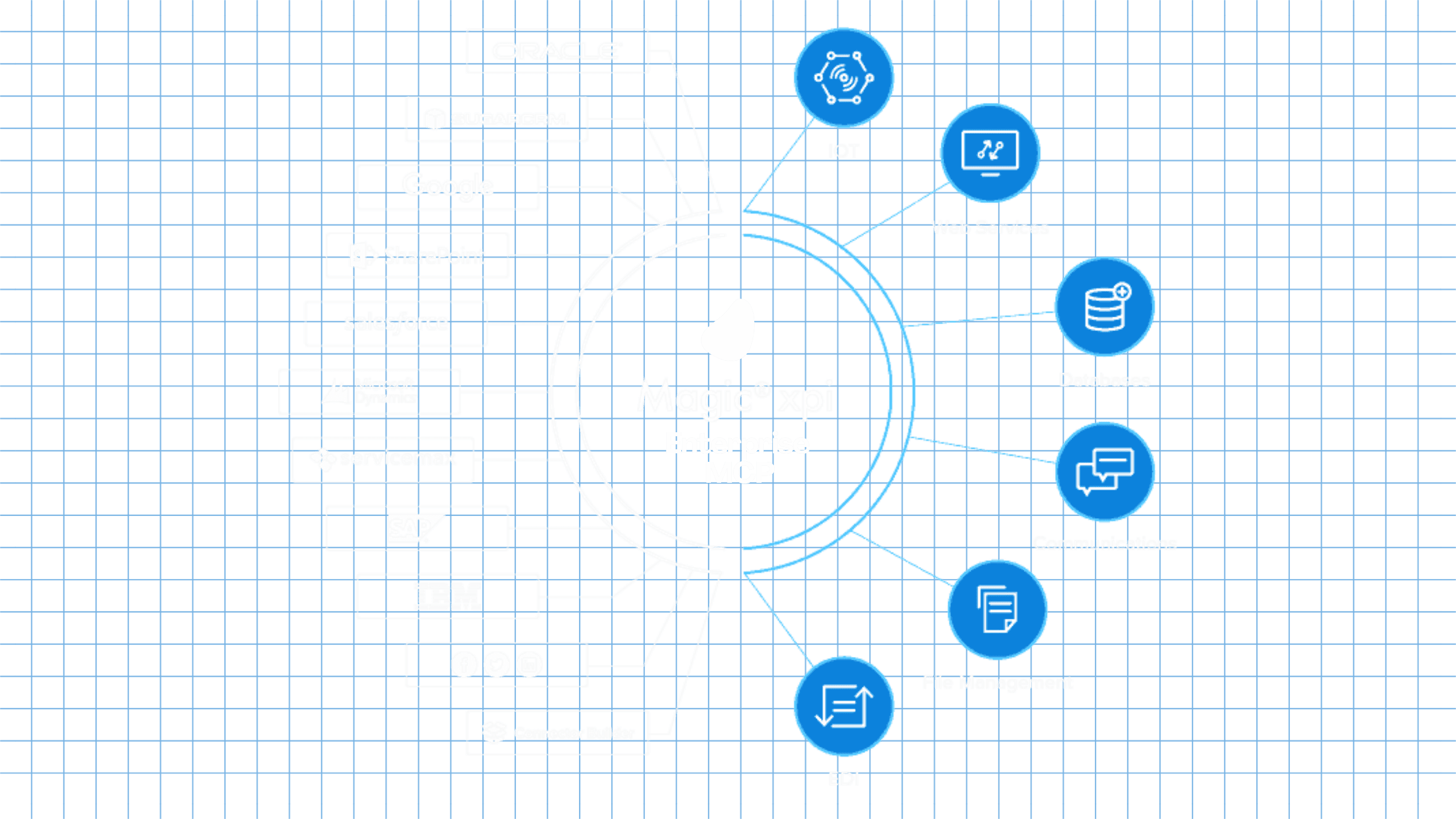
Enterprise integration across ERP, CRM, WMS, MES, HR, finance, support, historians and the plant floor.
Twelve systems have sixty-six possible pairs. You have not built sixty-six integrations — you have built the fifteen or twenty that somebody escalated hard enough to get funded. Each one was a project with a start date and an end date. None of them ever actually ended. Point-to-point integration doesn't accumulate like assets. It accumulates like debt.
How it was approved
What it became
The cost nobody put in the business case
Integration work that was approved as one project became permanent headcount.
Somewhere on your org chart there are people whose real job is keeping bespoke connections alive. They were hired to build things. They spend their quarters defending things. That is the most expensive way in the world to move a sales order from one database to another, and it is invisible in every budget review because it never appears as a line called “integration.”
Magic XPI replaces bespoke code with configuration, and scheduled batches with events. That sounds like a developer-experience argument. It isn't. It changes two numbers you actually care about: how much of your upgrade risk comes from integrations, and how many people have to still work here for your estate to keep running.
Code-free
Integration logic lives in a visual flow with explicit steps, mappings and branches — not in a repository only one engineer can read. A business analyst can follow it. A new hire can own it in a week instead of a year. The platform is the documentation.
Event-driven
Triggers fire on the event: an order posts, a shipment confirms, a work order closes, a record changes. No nightly batch window to protect, no polling job quietly failing at 2 a.m., no queue of stale data waiting for the clock.
Connector library
100+ pre-built and certified connectors handle authentication, schema, pagination and version differences. When a vendor changes an API, the connector absorbs it. You did not write that code, so you do not maintain that code.
One control plane
One place to see what ran, what failed, what retried and what is waiting. Central logging and recovery instead of twenty scripts with twenty different ideas about what an error is.
What changes about upgrade risk
Today an ERP or CRM upgrade means auditing every custom connection that touches it. With a certified connector in front of the endpoint, the version change is absorbed at the connector and your flows keep their shape. Upgrades stop being integration events.
What changes about staff dependency
Today the person who wrote a connection is the only one who can safely change it, which makes every resignation an architecture event. A configured flow is legible to the next person. Knowledge lives in the platform, not in one head and one inbox.
You have been pitched by firms whose “platform” is a folder of scripts and a methodology deck. Fair enough — it is the right thing to be suspicious about. So here is the substance, stated plainly enough to challenge.
Runtime
Our own in-memory middleware carries messages between steps rather than staging every hop in a database. Flows execute in memory with state held for recovery, which is what makes high-throughput, event-driven work practical instead of theoretical.
Availability
The runtime is built for high availability: in-flight work survives a node going away, and recovery is part of the engine rather than a script somebody wrote around it. Integration is production infrastructure, so it is engineered like production infrastructure.
Deployment
Run it in your cloud, in your data center, or split it — cloud for the SaaS endpoints, on-prem for the systems that will never be allowed out of the building. Hybrid is a first-class deployment, not a workaround, because most real estates are hybrid for reasons that are not going to change.
Governance
Every flow is an inspectable artifact with defined endpoints, mappings and error paths. You can answer what talks to what, what happens when it fails, and who changed it last — in a review, with a screen, in front of an auditor.
The honest boundary
We are not going to tell you a platform erases the work of agreeing what a customer record is, or which system owns price. Those are your decisions and they are the hard part. What the platform ends is the part where every one of those decisions turns into another bespoke program somebody has to keep alive forever.
Calling Magic XPI an ERP tool undersells it by roughly seventy percent, and it is the mistake that costs you the most, because the integrations that hurt are the ones that cross domains. Nobody loses sleep over a clean ERP-to-ERP feed. They lose sleep over a customer order that has to touch commerce, CRM, ERP, the warehouse, the line and support before anyone can answer “where is it?”
SAP, Oracle JD Edwards, Epicor, Infor and the rest of the estate — financials, inventory, production orders, master data.
ERP systemsSalesforce, SugarCRM and the quote-to-order path. Orders stop being retyped from one screen into another.
Order to cashWarehouse management, carriers, 3PLs and the EDI traffic your trading partners mandate rather than request.
EDIManufacturing execution, historians, SCADA and line-level data — the layer most enterprise integration tools quietly refuse to touch.
ManufacturingPayroll, onboarding, time capture, AP and the reconciliations that currently run on an exported spreadsheet and a person's memory.
Employee onboardingTicketing, field service and warranty — so the person on the phone can see the order, the shipment and the install base at once.
DistributionStorefronts, marketplaces and customer portals wired to live inventory, live pricing and real order status.
E-commerceProduct data, BoMs and revisions moving to the systems that build, buy and bill against them.
PLMThe plant floor is where most integration programs stop and hand the problem to a different vendor. We don't, because the controls engineers who work on the line are a division of this company, not a subcontractor we call when the scope gets physical. Enterprise data goes down to the floor and production reality comes back up through the same governed layer.
You will have to defend this choice to a CFO, a security reviewer and an auditor, probably in that order. These are the facts that hold up in all three rooms.
45 min
saved per order
Kinetico
Salesforce to JD Edwards, straight through. Forty-five minutes of manual handling per order that nobody has to do any more — on every order, every day.
650%
growth in online orders
Remtron
From two orders a day to fifteen. The storefront could finally be trusted with live inventory, pricing and order status, so the channel stopped being a brochure.
60+ hrs
saved weekly
Michelman
Sixty-plus hours a week returned to the business, with ROI in under ten months. That is the headcount argument, measured instead of asserted.
18 / 18
plants in weeks
Confidential
Eighteen plants deployed in eighteen weeks. One plant a week is only possible when the integration is configured and repeatable rather than rebuilt by hand each time.
Why the JD Edwards credential matters here
Being the only Oracle Validated Integrator in the Americas with a certified JD Edwards connector means Oracle tested our code against their product — not that we wrote a brochure about it.
This outcome is built mainly by Magic Integration, with Magic Consulting setting the roadmap and the sequencing. Both are divisions of Magic Software Americas. Not partners, not resellers, not a prime contractor and a bench of strangers — the same company, the same P&L, the same people on the call in month nine as in week one.
Primary delivery
Builds and runs the integration layer: flows, connectors, mappings, monitoring and the handover to your team. These are the people who have connected SAP, JD Edwards, Epicor and Infor estates to commerce, CRM, warehouses and plant floors enough times to know where the schema surprises live.
Magic IntegrationRoadmap and sequencing
Decides what to connect first and why, using the engagement model Assess, Target, Execute, Sustain. The order matters: connect the wrong six systems first and you have spent a year to make a dashboard slightly better. Connect the right two and the close gets shorter next quarter.
Magic ConsultingWe are the only company in the Americas with OT engineering, enterprise integration, bespoke application development, AI development and operational strategy under one P&L, without subcontracting any layer. For you that is not a brag, it is a risk reduction: when an integration problem turns out to be a controls problem, or a controls problem turns out to be a data model problem, nobody has a commercial reason to say it is somebody else's scope.
Combined group: 15,000+ professionals · 6,000+ customers · 50+ countries · 20+ offices worldwide · in business since 1983.
Every AI initiative that died in a pilot died for the same reason: the data it needed lived in six systems that disagreed, and nobody could say which one was right. Connecting what you already own isn't the unglamorous prerequisite to the interesting work. It is the work that decides whether the interesting work is possible.
The platform itself: the flow engine, the in-memory runtime, deployment options and how it is administered day to day.
Platform detailWhat the 100+ pre-built and certified connectors actually cover, endpoint by endpoint, so you can check your own stack against the list.
Browse connectorsHow this runs as integration platform as a service, and what moves when you take part of the estate to the cloud.
iPaaSA connected estate is the prerequisite for AI anyone will trust. Models are only as honest as the data plane underneath them.
Build trusted AIUsually because the last tool was bought as a license and never staffed, so it became one more thing to administer while the real work stayed in scripts. We deliver the flows, not just the platform, and Magic Integration is the division that builds them. If the answer to "who will actually configure this" is nobody, the tool does not matter — and we will tell you that on the call.
No, and that framing is the one we push back on hardest. ERP is one endpoint among many. The integrations that produce real outcomes cross domains: commerce to CRM to ERP to WMS to the line to support. If all you need is one ERP feed, you do not need a platform. If you need the estate to agree, you do.
Not on day one, and usually not all of them. We map what exists, pick the connections that carry the most risk or the most manual handling, and move those first. The old scripts get retired as flows replace them. Nobody funds a project whose only deliverable is parity with what already works.
Cloud, on-prem or hybrid, and that is your decision — hybrid is a supported deployment, not a compromise. You can run it yourself after handover, have us run it, or split it. We build for handover by default, because a flow you cannot operate without us is not actually configured, it is just outsourced.
That is what the certified connector is for. Version and schema differences are absorbed at the connector rather than in logic you own, so a vendor release stops being a regression hunt across twenty hand-written connections. It is the single biggest reason upgrade windows get shorter.
Start with the integration surface: the systems, the flows that already exist, the handoffs still done by a person with a spreadsheet, and the connections that break most often. That map is useful to you whether or not you buy anything from us, and it is the first thing we build.
Tell us which systems refuse to talk to each other and we will come back with the integration surface as we see it — what exists, what should be connected first, and what it would take. No deck.
Prefer to talk first? Book thirty minutes.